
How Often Should You Pump Your Septic Tank?

MILLION DOLLAR QUESTION: HOW OFTEN TO PUMP MY SEPTIC TANK?

Quick Take: Most septic tanks need pumping every 3 to 5 years, but the real answer depends on your tank size and how many people live in your home. A family of four with a standard 1,000-gallon tank should pump every 2 to 4 years. A two-person household with the same tank can often wait 4 to 5 years. The table below gives you typical intervals based on real-world experience pumping tanks in NE Ohio.

The Short Answer

The EPA recommends inspecting your septic system at least every three years and pumping the tank every 3 to 5 years. That range covers the average household, but your household is not average. A retired couple and a family of six produce very different amounts of wastewater, and that difference has a real effect on how fast your tank fills.

Think of it like changing the oil in your truck. A truck that sits in the driveway does not need oil changes as often as one hauling loads through Northeast Ohio winters. Your septic tank works the same way. The more waste that flows into it, the faster solids build up and the sooner it needs service.

The single best way to know your pumping schedule is to look at two numbers: your tank size and your household size. We built the table below to give you a direct answer.

Septic Tank Pumping Frequency Table

This table shows how often to pump your septic tank based on tank capacity and the number of people living in your home. These intervals reflect real-world experience pumping tanks across NE Ohio. Your actual schedule can vary depending on water usage, household chemicals, garbage disposal use, and other factors.

Tank Size1-2 People2-4 People5-6 People
1,000 gal3-5 years2-4 years1-3 years
1,500 gal4-6 years3-5 years2-4 years
2,000 gal5-7 years4-6 years3-5 years

How to use this table: Find your tank size in the left column and your household size across the top. The range where they meet is your typical pumping interval. If you are not sure of your tank size, most homes in NE Ohio with three bedrooms have a 1,000-gallon tank. Homes with four or more bedrooms typically have a 1,500-gallon tank.

Key takeaway for a family of four: With a 1,000-gallon tank, plan on pumping every 2 to 4 years. With a 1,500-gallon tank, you can typically go 3 to 5 years between pumpings.

Five Factors That Change Your Pumping Schedule
The table above gives you a solid starting point, but five things can shift your actual schedule earlier or later.

1. Household Size — This is the biggest factor. The EPA notes that the average person uses about 70 gallons of water per day indoors. Each additional person adds roughly that much daily flow through your septic system.

2. Tank Size — Larger tanks provide more room for solids to accumulate. If your home has been expanded, confirm your tank capacity matches your current usage.

3. Water Usage Habits — Running multiple laundry loads back to back, long showers, and leaking fixtures all speed up how fast your tank fills. A single leaking toilet can add up to 200 gallons per day, according to the EPA.

4. Garbage Disposal Use — Food waste adds solids faster than human waste. Some septic professionals recommend pumping 50% more frequently if you use a garbage disposal regularly.

5. Household Products and Chemicals — Harsh cleaning products and chemicals kill the beneficial bacteria in your tank. Stick to septic-safe products and avoid dumping paint, solvents, or grease into your drains.

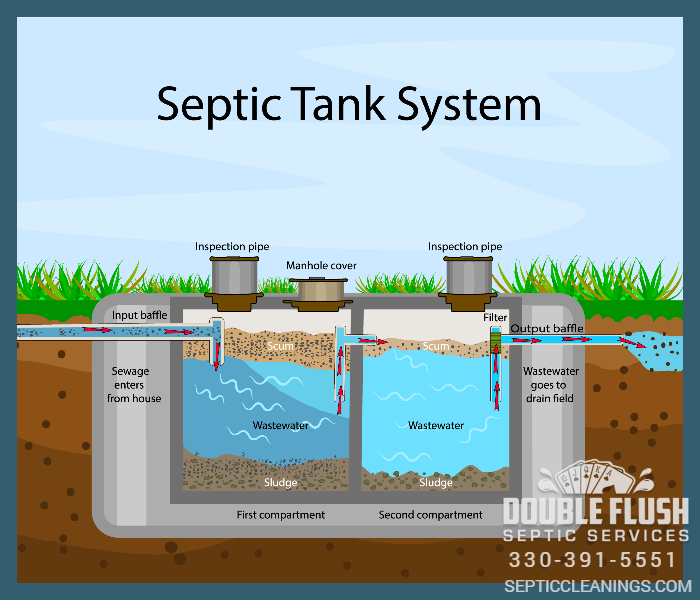
Septic tank system with Double Flush septic services for efficient waste management.

Signs Your Septic Tank Needs Pumping Now

  • Slow drains throughout the house. A single slow drain is usually a clog. When every drain is sluggish, the tank is probably full.
  • Sewage odor near the tank or drainfield. Solids may have risen above the outlet level.
  • Standing water or soggy ground over the drainfield. Liquid waste is pushing out faster than the soil can absorb it.
  • Sewage backup in the house. Call for emergency septic service immediately.
  • Unusually green grass over the drainfield. Escaping effluent may be fertilizing the soil.

If you notice any of these, call Double Flush at (330) 391-5551.

What Happens If You Skip Pumping

When solids rise too high, they flow into the drainfield. Drainfield pipes are designed for liquid only. Solids clog pipes and soil, leading to failure. Drainfield replacement typically costs $5,000 to $20,000 or more, compared to $300 to $600 for a routine pump-out. Consider a maintenance plan if you want to set it and forget it.

How We Measure Your Tank (The Sludge Judge)

You do not have to guess when your tank needs pumping. We use a tool called the Sludge Judge to measure exactly how full your tank is. It is a clear plastic tube we lower into the tank through the access port. It takes a core sample from top to bottom, showing us the scum layer on top, the clear liquid zone in the middle, and the sludge layer at the bottom.

The EPA says your tank should be pumped when sludge and scum together fill more than 25% of the total liquid depth. We measure these levels precisely, so we can tell you whether your tank needs pumping today or whether you can safely wait another year. No guesswork, no unnecessary pump-outs.

Want to know where your tank stands? Call us at (330) 391-5551 or schedule an inspection online.

Septic Maintenance Tips Between Pumpings

Watch what you flush. Only human waste and toilet paper belong in a septic system. No wipes, no feminine products, no cat litter. Read more about whether septic-safe toilet paper is necessary.

Spread out water usage. Space heavy water use throughout the day and week to avoid flooding your tank.

Protect your drainfield. No vehicles, no trees with invasive roots. Our guide on protecting your drainfield covers this in detail.

Skip the additives. Your tank already has the bacteria it needs. Read our take on whether septic systems need added bacteria.

Frequently Asked Questions

How often should I pump my septic tank for a family of four?

A family of four with a 1,000-gallon tank should pump every 2 to 4 years. If your tank is 1,500 gallons, you can typically go 3 to 5 years between pumpings. Heavy water use or regular garbage disposal use may shorten the interval.

How much does it cost to pump a septic tank?

Most residential pumpings in NE Ohio cost between $300 and $600. Double Flush also offers financing options for larger projects.

Can you wait 10 years to pump a septic tank?

For most households, no. A family of three or more will overfill a standard tank well before 10 years. Waiting too long risks drainfield damage and repair costs far exceeding the cost of regular pumping.

Does a septic system work when the power goes out?

Standard gravity-fed systems work without electricity. Systems with pumps or aerators will lose those functions. Our full guide on septic systems during power outages has more detail.

For more tips on maintaining your septic system, call or text us at (330) 391-5551.

24/7 EMERGENCY SEPTIC SERVICES NEAR YOU

We service the Northern Ohio area including ErieLorainMedina, Portage, Stark, Summit and Wayne counties. Our family-owned septic company is the one to call for all of your emergency septic tank services, including septic tank pumping. We can work around your schedule when it’s convenient for you, including working on weekends and evenings.

Our goal is to be the Best Septic Services Company Near You!

We want to save you money by maintaining the health and extending the life and of your septic system. We aim to be the best septic services company near you. Please leave us a review and let us know how we did.