
How Septic Tank Pumping Works
If you have never watched your septic tank get pumped, the whole thing can feel like a mystery. A truck shows up, a hose goes in the ground, and an hour later it is done. This article walks through what actually happens during a pumping visit, start to finish, so you know what you are paying for and what we look at while we are there. If you already know you are due and just want to get on the schedule, head straight to our septic tank pumping page.
What “pumping” actually means
Pumping is the act of removing the built-up contents of your septic tank. Over time, solids settle to the bottom as sludge, lighter material floats to the top as scum, and the liquid sits in the middle. Pumping clears that buildup so the tank has room to do its job again.
People often use “pumping” and “cleaning” to mean the same thing, but they are not identical. Pumping is the removal. Cleaning is the broader maintenance visit that includes the pump-out plus a closer look at the working parts of the tank. Our septic tank cleaning page covers that side. The rest of this article is about the pumping process itself.
Step 1: Locating the tank and access lids
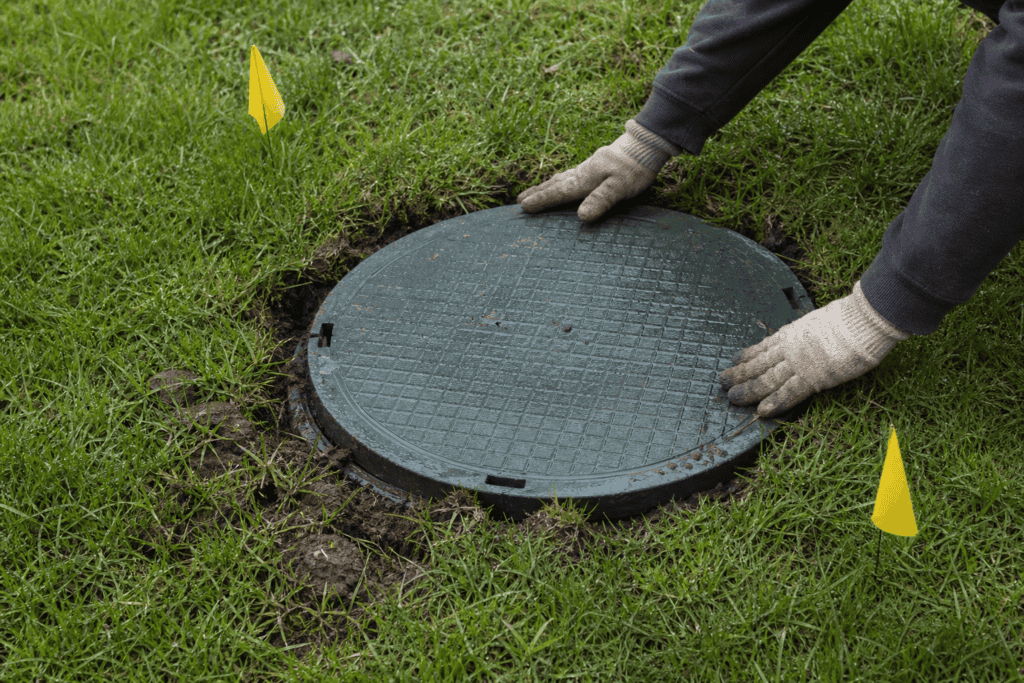
The first thing we do on arrival is find the tank and its access lids. On some properties the lids sit right at the surface and the job starts in minutes. On others they are buried under a few inches of soil, sod, or a flower bed that grew in over the years.
You can save time here. If you know where your lids are, mark them before we arrive and clear anything sitting on top. Digging up buried lids is normally an extra step, and it is the easiest part of the visit to plan around. Your original system records or a county permit drawing help us find everything on the first try.
Step 2: Opening the tank and checking what’s inside
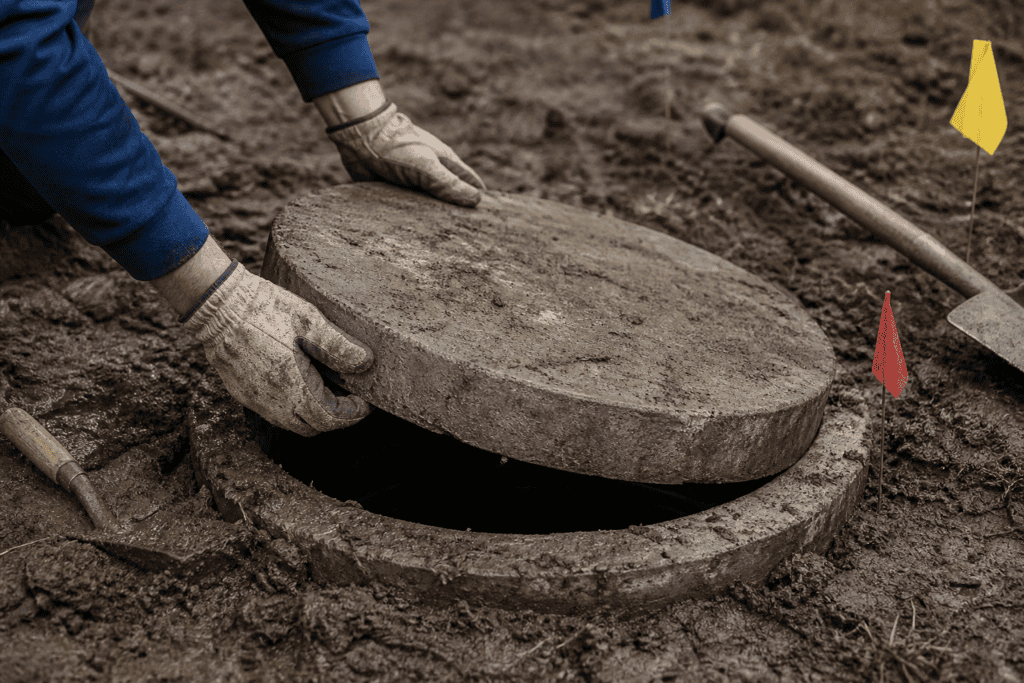
Once the lids are open, we look before we pump. With the tank still full, we can read things that disappear the moment the waste is gone. We check the depth of the sludge on the bottom and the scum layer on top. EPA guidance is that a tank is due when the scum layer sits within six inches of the outlet or the sludge comes within twelve inches of it, so those layers tell us whether you were on schedule or overdue.
We also watch the outlet. If effluent flows back into the tank from the outlet pipe while we work, that points to a drainfield that is waterlogged and struggling, which is something you want to catch early instead of after a backup.
Step 3: Pumping the waste
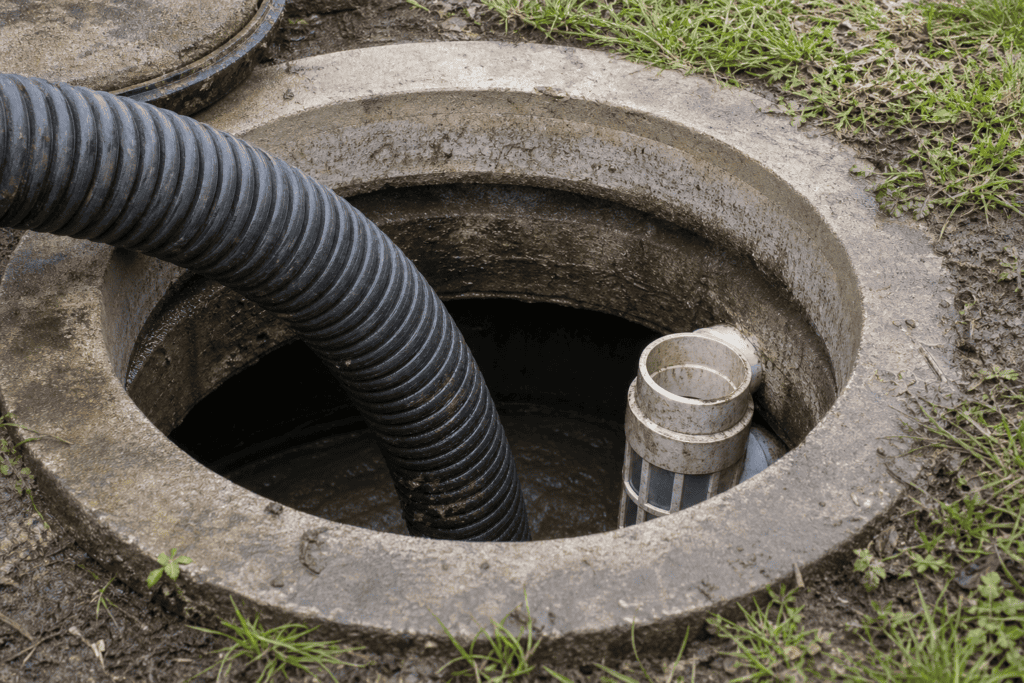
This is the part most people picture. We run a large hose from the vacuum truck into the tank, pump the tank down, and remove the built-up waste. A thorough pump-out is more than skimming the liquid off the top. As Penn State Extension puts it, “the scum layer must be broken up and the sludge layer mixed with the liquid portion of the tank” to get everything out. So we work the hose across the bottom and break up the crust on top, mixing as we go, until the solids actually leave the tank instead of settling right back down.
A typical pump truck holds a few thousand gallons, which is enough to service a normal residential tank in a single trip. That is why one truck handles most home visits.
Step 4: Inspecting baffles, filters, and tank condition
After the pump-out, with the tank pumped down, we can see the parts that matter. The outlet baffle, or tee, is a simple piece that does an important job. The EPA describes it as “a T-shaped outlet which prevents sludge and scum from leaving the tank and traveling into the drainfield area.” If that baffle is cracked or missing, solids can escape and damage the drainfield, so we check it every time.
Some tanks also have an effluent filter on the outlet. NC State Extension notes that systems installed since 1999 often include one, while older tanks usually do not. If yours has a filter, we check it while the tank is empty. We also look the tank over for cracks, root intrusion, and worn riser seals. Filter and component detail by system type lives on our septic tank cleaning page.
Step 5: The walkthrough with you
Before we pack up, we tell you what we found. If the baffle looked good and the tank is in solid shape, you hear that. If a filter needs attention or a riser seal is failing, you hear that too, along with what we suggest and when your next visit should land. You talk to the same crew that did the work, not a call center. The point of the walkthrough is that you drive away knowing the real condition of your system instead of only a paid receipt.
Trying to figure out if you are due? Call or text and we can help. If it is time, we will get your septic tank pumping on the schedule.
Common questions customers ask during a pump-out
Why do you backflush?
Backflushing helps us thoroughly remove sludge from the system. Sometimes it takes multiple backflushes to get the sludge moving. When that happens, it usually means the sludge is extremely thick and the tank was way overdue for cleaning.
Why don’t you pump the tank bone dry?
For an active system, we leave a few inches in the tank to help preserve the bacteria and keep the system healthy. Pumping a tank dry is usually for abandonment, not a normal cleaning or pump-out.
Why was the visit faster than my last company?
We clean a lot of septic systems. We have a system, we know the job, we carry clean water, and we have everything we need to finish efficiently and thoroughly.
Can your trucks handle tight access?
We have two different size trucks to accommodate newer driveways, tight spaces, and homeowner preference.
What happens if you see a repair issue?
If we see an issue or concern during the visit, the technician notes it on the invoice. There is no pressure sales pitch. The customer decides if and when they want to address the repair.
How long does septic tank pumping take?
The honest answer is that it varies. In our experience the actual pump-out usually runs about an hour for a normal residential tank once the lids are open. What moves that number is mostly access and condition. Virginia Tech Extension notes that the time “will depend on how quickly and easily the septic services can access the tank and the size of the tank,” and that “unforeseen circumstances such as broken baffles and roots getting into the system” can add to it.
A tank with surface lids that was pumped a few years ago goes quickly. A large tank with buried lids that has not been touched in years takes longer. We would rather give you an accurate window than a number that ignores what we find when we open the lid.
Where does the waste go after the truck leaves?
The waste we pump out is called septage, and it travels a regulated path to a licensed facility. In Ohio, septage hauling falls under Ohio Administrative Code 3701-29, which is administered by the Ohio Department of Health. Haulers register with the local board of health and keep a manifest for every load.
That manifest records where the waste went. Under the rules, septage goes to a permitted wastewater treatment plant or an approved land-application site. So the contents of your tank end up at a licensed facility built to handle them, with a paper trail the county can check, from your lid to final disposal.
What you can do between pumpings
Most of what keeps your tank healthy happens between visits, and it comes down to what goes down the drain.
Watch your water use. Spread laundry across the week and fix running toilets, because a steady overload pushes solids toward the drainfield before they have settled. Be careful what you flush. Wipes labeled “flushable,” grease, coffee grounds, paper towels, and harsh chemicals all cause problems. The safe rule is human waste and toilet paper.
Go easy on additives. A healthy system does not need them, and the bottle promises rarely match what your tank actually requires. Our guide on septic tank additives covers when they help and when they are a waste of money.
When to schedule your next pumping
EPA guidance is that household tanks get pumped every three to five years, but the right interval depends on your tank size, how many people live in the home, and how you use water. Here is the real-world guidance we use across Northeast Ohio:
| Tank size | 1-2 people | 2-4 people | 5-6 people |
|---|---|---|---|
| 1,000 gal | 3-5 years | 2-4 years | 1-3 years |
| 1,500 gal | 4-6 years | 3-5 years | 2-4 years |
| 2,000 gal | 5-7 years | 4-6 years | 3-5 years |
These ranges are starting points, not hard rules. Heavy water users and households that run a lot through a garbage disposal land at the shorter end. Lighter use and a recent clean inspection let you push toward the longer end. For the full breakdown of what moves you up or down the schedule, see our post on how often to pump your septic tank.
Ready to schedule?
Now you know what a pumping visit involves: we locate the tank, read it before we pump, remove the built-up waste, check the baffles and filter, and walk you through what we found. We are a family-owned company (STKB Operations LLC) covering nine counties across Northeast Ohio.
If you are due, or just not sure, call or text us at 330-391-5551 and we will get your septic tank pumping on the schedule. You can also reach us through our contact form.


